

Peter Crane

Peter Crane’s introduction to straight-line acceleration came in the early sixties when his interest in bikes led him to meet bike sprinter Bill Bragg. Teaming up with Bill he competed in sprints at Duxford and Ramsgate on his modified Triumph 500 street bike while Bill ran his Triumph “Yellow Peril”.
In 1965 Peter emigrated to California where he worked for Carroll Shelby. While there he would wander off to Lions Drag Strip and was blown away by the wild AA/Fuellers smoking the full quarter. He was particularly impressed by the Gassers built from small British cars with huge American engines which bounced their way down the strip and could also be seen cruising the boulevards or street racing when the cops weren’t looking. Peter returned to the UK the following year and got a job working for Alan Allard in Putney. The job included fitting Shorrock Superchargers to customers’ cars and he also bolted one to his own ’64 Cortina then took it along to the newly-opened Santa Pod Raceway for his first of many blasts down its illustrious blacktop.
Peter then started up his own car business in Bromley, just round the corner from Bob and Roy Phelps’ Fibre Glass Repairs and some years later got Bob and Roy to build a ‘glass Austin A40 body as Peter was now building a street/strip Gasser with 400 cubic inches of Pontiac power, no doubt inspired by the cars he had seen in California. Unfortunately due to work commitments Peter had to sell it before completing the interior and paint job and Cliff Jones finished it off as “Devon Cream” winning many awards at the Custom Car Shows in the early 70s.
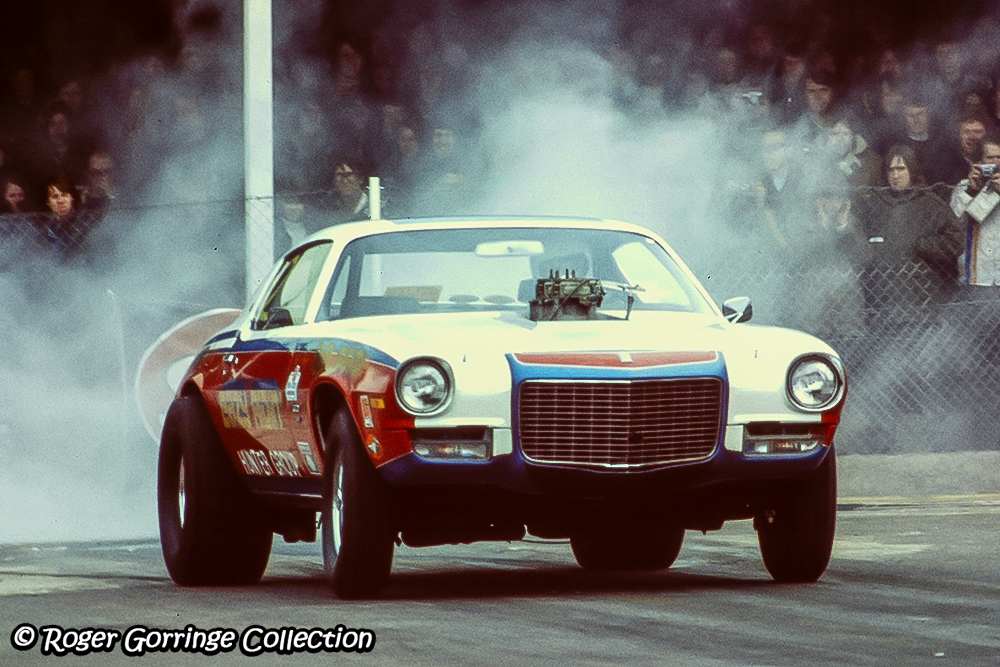
Late in 1972 Peter and his long time buddy Ray Edmondson decided to go halves in buying a turnkey …
Terry Gibbs

In 1973 Terry Gibbs bought a 1967 Chevy Corvette Roadster. This started a love affair with the American car scene, which his family still share today. But it was in 1976 that he purchased a 1969 Camaro, which was to be the first of many Camaros that would pass through his hands including ‘Black Magic’ and ‘Money Hungry’. It was this first Camaro that prompted Terry to incorporate and take on the Chairman’s role of the first ‘Camaro Club of Great Britain’ and being invited as special guest of the Camaro Club America to the 1978 Ontario World Finals was a particular highlight of this time. In 1979 Terry first started drag racing at Blackbushe in the Street classes, and he continued to do so through the early to mid eighties, racing at York, Santa Pod and Long Marston. He later went on to setup “Camaros Unlimited” importing Camaros and Corvettes.
In 1991 Terry imported the “Obsession” 1969 Camaro to race in Super Gas. Tony Gransden drove for the first two years then Terry took over from 1993 until 1997 when his son and crewman Craig took over the hot seat as Terry was beginning to get involved with the promotional side of drag racing. In 1995 Terry took over as Chairman of the Super Gas Drag Racers Association and as part of this rȏle took about organising and promoting the first and legendary Super Gas tour to Hockenheim, where he managed to assemble no fewer than twelve British teams to take on the might of the Europeans. He organised the Super Slam meeting at Avon Park in August 1997 which was a great success leading to him signing up with track owner Anthony Hodges to run four Super Series meetings at Avon Park in 1998. Again these were a …
Brian Sparrow

Early drag racers will know the name Brian Sparrow, even though it may not be familiar to those who are relatively new to the sport. Through his efforts, Brian can rightly be regarded as one of the founding fathers of drag racing in this country.
He is a true motor sport enthusiast in the broadest sense – both 2 and 4 wheeled – with a wide ranging love of all things to do with speed and power. Make that no wheels as well, for in his teens he raced hydroplanes for a couple of years.
Brian served an apprenticeship at Heathway Engineering before doing National Service, and then embarking on a career in technical writing. Heathway was a feature in a number of early drag racers lives, but Brian’s time there did not coincide with that of Allan Herridge or Peter Bartlett.
It is very appropriate for Brian to be awarded a ‘Bootsie’. He was one of the three founders of Dragster Developments, along with Allan Herridge and John Harrison. They produced one of the first dragsters seen in this country, a straight 8 Buick in 1962, and made parts for many early racers.
Originally interested in hill climbs and motorcycle sprints, Brian was an early Competition Secretary of the National Sprint Association. Interestingly, it was at a regular NSA social meeting that Brian and Allan were first introduced to each other by the late NSA club founder, Len Cole.

There was a general feeling of antipathy towards the car racers in those times, and yet in the 1960s Brian managed to combine being on the committees of the NSA, British Hot Rod Association, and the British Drag Racing Association all at the same time! It says much for his …
Pete Davies

Pete Davies: Manufacturer of Puma Motor Cycle/Drag Race Components
Pete was born in 1944 in Crick, Northamptonshire, where he still lives. By his own admission he was not very clever at school until a new Head Teacher encouraged him to do art and handicrafts. This was when he discovered that working with his hands rather than his brain, and the understanding of scale and proportion, are as important in art as it is in designing cranks or chassis.
Pete did a five-year apprenticeship at a big steam turbine works and then some years at Lodge Plugs. Working for four years in a sub-contract shop taught him a lot of shortcuts and, as it had a fabrication shop, he picked up some ideas on welding and general metalworking. Whilst there he started racing grass track sidecar, first as a passenger then as the driver: it seemed safer to have the controls. Pete manufactured a lot of parts including timing covers, clutches, barrels and super strong crank cases for his own bike, which was a blown Triumph, and he did the same for many other competitors. After being made redundant in 1972 he thought he had enough work to set up on his own, but not having the run of machinery he had been using, he had to buy a new Lathe – which he still uses to this day – to machine cranks and crank cases.
As most grass track outfits were built around cut down BSA or Norton frames and the chair tubing was 10swg they came out heavy, so Pete took the best ideas from lots of outfits including road racing to design a complete chassis with leading link forks, side car suspension and a glass fibre seat moulding. He made the hubs, calipers and fuel tank resulting in …
Harlan Thompson

The World Series at Santa Pod in September 1980 saw the largest ever entry of nitro Funny Cars in one place outside the USA. Twenty teams from Sweden, Norway, America and the UK were there to qualify for a sixteen-car field including Don Prudhomme, Tom Hoover and Gene Snow, but when the smoke had cleared only one winner emerged: a little-known American racer called Harlan Thompson driving the Knut Söderqvist-owned “Tre Kronor” Plymouth Arrow. The fans certainly knew him now…
Harlan’s life changed quite dramatically when, at the tail end of the seventies, he had a chance meeting with Swedish racer Knut Soderqvist who was visiting the famed Central Jersey Speed & Machine in Fords NJ, one of the original east coast speed shops and Harlan’s local speed shop from his beginnings in Jersey. The pair visited a few races together, became friends and eventually Knut asked if Harlan would come to Europe and race a Top Fuel Dragster. The offer was declined, but when Knut later suggested the same deal with a Fuel Coupe, Harlan leapt at the chance.
Soon Knut had purchased a Plymouth Arrow previously campaigned by one of Harlan’s early heroes Ed “the Ace” McCulloch, they ran the car a couple of times in the US to check it out then had it painted at the fabled Circus Custom Paint shop prior to shipping to Sweden.
One year later Harlan was back at Santa Pod driving the “American Graffiti” Dodge Omni Funny Car in the 1981 World Finals. Could he win again? It didn’t look like it when he came up against favorite Tom Hoover in the “Showtime” Corvette in round two but despite a strong 6.32 from Hoover, Thompson tripped the win light with a fantastic 6.20/218 mph! This put him in the semis where …