


How times have changed. Sixty-five years ago, the first encounter between the Royal Automobile Club and the emerging American sport known as Drag Racing was awkward. Then, the RAC governed the UK’s four-wheeled motorsport and had rules and regulations for everything with which it was familiar. In America, Drag Racing, with its principal sanctioning body the National Hot Rod Association, was barely a decade old as an organised sport. To the RAC, it was an alien interloper when it arrived on Britain’s shores in 1961.
Drag Racing’s first public manifestation here was a dragster built by Sydney Allard, the London sportscar manufacturer and entrepreneur. Allard had raced at Le Mans and had twice won the Monte Carlo Rally, the only driver to do so in a vehicle of his own manufacture. Latterly, he had developed an interest in sprinting (for which the RAC had rules) and thought one of those new-fangled American dragsters might help further that interest. To comply with the RAC’s sprinting rules, Allard was obliged to fit an engine cover (a ‘bonnet’) and front-wheel brakes, which explains why the car, now housed in the National Motor Museum at Beaulieu, appears not to resemble the American dragsters on which it was based. Moreover, its design was culled from a 1959 American magazine and was already two years out of date compared to its transatlantic counterparts in the fast-developing sport.
By 1964, Drag Racing had overtaken sprinting as Allard’s prime interest and he collaborated with NHRA’s president, Wally Parks, to import America’s leading drag race stars to race on a selection of British airfields. RAC rules at that time did not countenance advertising on competition cars, and the RAC scrutineer at the opening event at Blackbushe in Surrey refused to allow the American cars to run while still adorned with sponsors’ stickers, which the Americans refused to remove. The impasse was finally resolved when the scrutineer was advised that the 20,000 spectators who had gathered from far and wide to see the American cars in action might riot if denied the opportunity.
Until 1975, the RAC Competitions Committee had been the body governing motorsport in the UK, overseeing rules implemented by individual motor clubs, of which the RAC was most prominent. That year responsibility was transferred to the Motor Sports Council. In 1979, the RAC Motorsports Association Ltd., known generally as the MSA, was formed to look after day-to-day running of the sport, standardising rules and their enforcement for motorsport events in the UK.
“It is a truth universally acknowledged that good governance is in want of a degree of unity among the governed”
In the 1970s the Drag Racing scene had become fragmented, with different clubs and organisations pursuing their own agendas and ambitions. Moreover, tensions between Drag Racing and the RAC/MSA had remained. To the MSA, drag racing still felt like an interloper, and the regulations and protocols which the body applied to its other entities did not mesh easily with the straight-line sport. In the mid-1980s, four on-track deaths sustained in the space of a couple of years challenged Drag Racing’s reputation as a generally safe undertaking and helped set in motion moves to establish a more unified approach. Prompted by MSA officials Ron Smith, Neil Eason-Gibson and Peter Todd, delegates drawn from different Drag Racing organisations formed an Inter-Club Committee aimed at standardising the conduct of the sport. This led to the formation of the MSA’s first dedicated Drag Racing Sub-Committee – Ron Smith was its first chairman, succeeded by John Ledster – and the development of the White Book of Drag Racing-specific rules as an adjunct to the MSA’s Blue Book of general regulations. The White Book’s chief compiler, erstwhile Drag Racer Philip Evans, subsequently chaired MSA/Motorsport UK’s Speed Committee, covering autocross, rallycross, sprinting and hill climbing as well as Drag Racing. The rapprochement led, among other things, to the development of an MSA national championship, first represented by the Top Methanol Dragster class and now, since 2007, by Pro Modifieds in the form of the FuelTech Motorsport UK British Drag Racing Championship.

The White Books original chief complier, Drag Racer Philip Evans, subsequently chaired MSA/Motorsport UK’s Speed Committee
Over many years, officials have come to Drag Racing from the RAC/MSA to perform supervisory roles, possibly with some trepidation at the start, and have grown to understand and appreciate its unique qualities. Scrutineers such as Captain Tom Hales, Amos Meekins and Glen Stockton and stewards such as Geoff May and, recently, Elaine and David Brice have all earned the sport’s respect. It is to MSA’s credit that, in time, a growing level of trust allowed the sport to develop a set of protocols applicable to its own discipline rather than try to impose from above rules homed in the more familiar worlds of circuit racing and sprinting.
The MSA underwent radical change in 2019 when governance passed to an entirely independent body, Motorsport UK, though still informed and advised by the Motor Sports Council. Now representing 100,000 members, over 600 clubs and permitting 3,400 events per year, the FIA-recognised National Sporting Association’s role has also evolved. In addition to implementing and enforcing the National Competition Rules and Regulations, Motorsport UK’s remit includes strategic leadership and promotion of the sport as well as the ongoing training of marshals, officials and scrutineers.
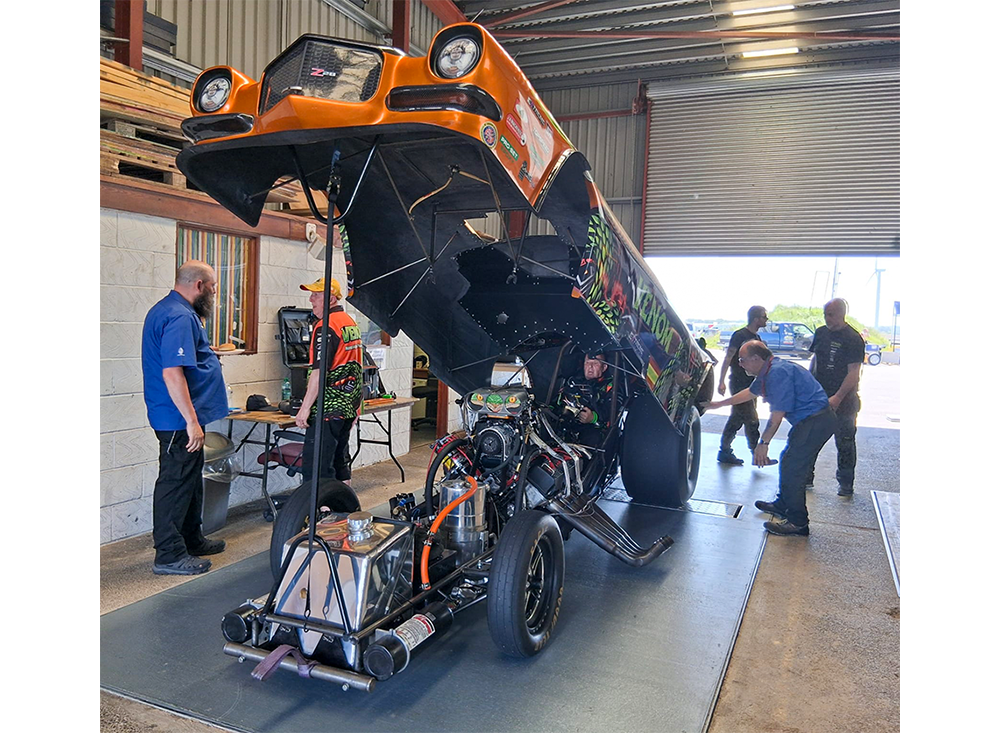
Motorsport UK personnel at work on the Venom Funny Car in SPR’s scrutineering bay 4
Photo: Lesley Wright
There have been notable occasions when the MSA/Motorsport UK relationship has proved its worth to Drag Racing. The MSA’s sanction helped smooth the way to the sport’s acceptance by the FIA, with the founding of the FIA Drag Racing Commission and the launch of the FIA European Drag Racing Championship. The directors of the Hall of Fame themselves owe a debt of gratitude as the MSA’s support was vital in the formation of our limited company and the granting of charitable status to the Benevolent Fund. And when Covid struck in 2020, Motorsport UK’s support enabled Santa Pod Raceway to obtain a life-saving government financial loan.
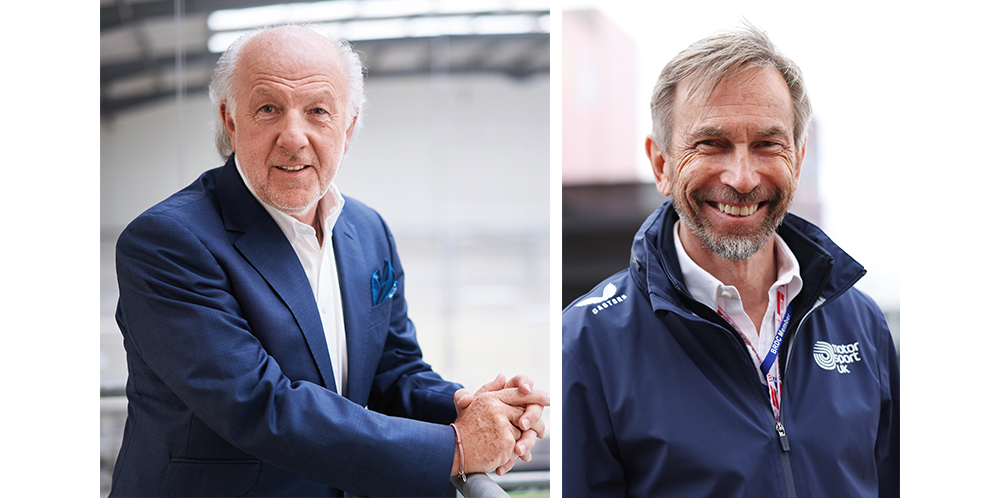
Dave Richards, Chairman, Motorsport UK (L) & Hugh Chambers, CEO, Motorsport UK (R)
Drag Racing claimed a moment of motor racing history in 2016 at Santa Pod’s National Finals when for the first time at an MSA-sanctioned event, all three senior officiating roles were occupied by women: Carole Ismail, Race Director/Clerk of the Course; Kathy Taylor, Race Meeting Secretary; and Elaine Brice, MSA Steward.
It is for the furtherance of a relationship that began long ago in an atmosphere of disharmony but over the decades carved its own path through the thicket of British motorsport to become one of mutual respect and support, and as a token of gratitude from the sport to the governing body and its key officers, that Motorsport UK is hereby inducted into Membership of the British Drag Racing Hall of Fame.
Profile by Robin Jackson